Showing posts sorted by relevance for query fed. Sort by date Show all posts

Tuesday, December 4, 2018

Market close 12/4/2018 inverted yield curve...


The 10 year treasury bond yield jumped up during the night of 10/3/2018 causing the sell off on 10/4.
Now the inverted yield curve causes the selloff on 12/4.

"inverted yield" = 1381 (Jewish) 221st prime
"inverted yield" = 152 (English Ordinal) SUM 300
Rosh Hashana 5780 is 300 days from 11/28/2018

Today is the 84th day in the Jewish/Islamic year
From and including: Tuesday, September 11, 2018
To, but not including Tuesday, December 4, 2018
Result: 84 days
Or 2 months, 23 days
Or 12 weeks

DoubleLine's Gundlach says Treasuries point to economy ready to weaken.

DECEMBER 4, 2018 / 11:46 AM

NEW YORK (Reuters) - Jeffrey Gundlach, chief executive officer of DoubleLine Capital, said the U.S. Treasury yield curve inversion on short-end maturities was signaling the “economy is poised to weaken.”

U.S. two-year Treasury yields rose above three-year Treasury yields on Tuesday for the first time in more than a decade as traders piled on bets the Fed might be close to ending its rate-hike campaign. The Dow Jones Industrial Average closed down nearly 800 points, or 3.10 percent, and the Standard & Poor’s 500 fell over 90 points, or 3.24 percent.

“If the bond market trusts the Fed’s latest words about ‘data dependency’ then the totally flat Treasury note curve is predicting softer future growth (and) will stay the Fed’s hand,” said Gundlach, who oversees more than $123 billion in assets.

“If that is indeed to be the case, the recent strong equity recovery is at risk from fundamental economic deterioration, a message that is sounding from the junk bond market, whose rebound has been far less impressive,” he said.

Yield curve inversions are seen generally as precursors of a recession. An inversion of the two-year and 10-year yields has preceded each U.S. recession in the past 50 years.

So far, there has been no inversion of the two-year and 10-year. The benchmark 10-year yield clung to an 11-basis-point margin over its two-year counterpart, although it was the smallest in over a decade.

https://www.reuters.com/article/us-funds-doubleline/doublelines-gundlach-treasury-curve-inversion-signal-economy-poised-to-weaken-idUSKBN1O3244?utm_source=Twitter&utm_medium=Social

U.S. Treasury yield curve inversion

"inverted bond yield" = 1122 (English Sumerian)
"U.S. Treasury yield curve inversion" = 104 (Chaldean)
"yield curves" = 58 (Jewish Reduction)

"bond yield curve inversion" = 277 (Jewish Ordinal)
"bond yield curve inversion" = 1089 (Satanic) 
square root 33 

The yield curve is a graph of interest rates on government bonds by their months or years until the bonds' principal must be repaid. The yield curve typically shows those rates for the Fed Funds rate (which is very short term), 3-month, 2-year, 7-year, 10-year, and 30-year.

As I first learned when I read William Greider's, Secrets of the Temple, the yield curve typically slopes upward -- with short-term rates lower than long-term ones.

The reason is that when the economy is expanding, investors are optimistic about the future so they are eager to borrow money at low rates and invest it in assets that they believe will grow in value and pay off in the future.

However, as Greider explained so well, the Fed can engineer a recession by raising short-term rates -- signaling its pessimism about the future -- and in so doing, causing the yield curve to invert.

An inverted yield curve means that short-term interest rates are higher than longer-term ones. The inverted yield curve is what happens when investors are bidding for longer-term bonds -- thus driving down their yields -- because they are pessimistic about the short-term prospects for the economy.

The most extreme case of this was in the early 1980s when Fed Chair Paul Volcker wanted to rid the U.S. economy of inflationary expectations by hiking the Fed Funds rate up near 20%.

This strategy caused a whopping recession as short-term credit became very expensive and people saw no reason to take the risk of investing for the long-term when they could put their funds in a money market fund and earn a nearly 20% return.

One particular yield curve -- the one for U.S. Treasury Department securities -- is a particularly powerful predictor of economic conditions. These are sold in 12 maturities -- One-month, two-month, three-month, and six-month bills; One-year, two-year,  three-year, five-year, and 10-year Treasury notes. and 30-year bonds, according to The Balance.

As The Balance wrote:

So why does the yield curve invert? As investors flock to long-term Treasury bonds, the yields on those bonds fall. They are in demand, so they don't need as high a yield to attract investors. The demand for short-term Treasury bills falls. They need to pay a higher yield to attract investors. Eventually, the yield on short-term Treasurys rises higher than the yield on long-term bonds and the yield curve inverts.

On December 3, the yield curve inverted a little bit -- the first time since the 2008 recession. The yield on the five-year note of 2.83 was 1 basis point (100 basis points = 1%) lower than the yield of 2.84 on the three-year note.

This is investors' way of saying that the economy will be a little better in 2023 than it will be in 2021.

The Treasury yield curve has been a good predictor of recessions in the past -- offering warnings of the recessions of 2000, 1991, and 1981.

But for the 2008 financial crisis, the yield curve was early. The first inversion occurred on December 22, 2005. The Fed was concerned about a housing bubble and started raising rates in June 2004 -- by the end of 2005, the fed funds rate was 4.25%.

The two-year Treasury bill yield hit 4.41% -- but the 10-year note was a bit lower -- at 4.39% -- the first inversion of -2 basis points.

The Fed kept raising rates -- they hit 5.25% in June 2006 -- and by July 2006, the yield on the 2-year note was 5.12% -- 5 basis points more than the 10-year note's 5.07% yield, according to The Balance.

The yield curve stayed inverted for almost a year and it was not until September 2007 that the Fed started lowering the Fed Funds rate to 4.75% -- cutting them to zero by the end of 2008.

The yield curve was then upward sloping -- but the economy was in free fall.

https://www.forbes.com/sites/petercohan/2018/12/04/795-point-dow-plunge-and-the-inverted-yield-curve/

In the 2008 crisis the first inversion occurred on 12/22/2005 

12+22+20+05=59
12+22+2+0+0+5=41
1+2+2+2+0+0+5=14

From and including: Thursday, December 22, 2005
To, but not including Tuesday, December 4, 2018
Result: 4730 days
Or 12 years, 11 months, 12 days 121112 , 1112

in 18 days it will be 13 years....
From and including: Tuesday, December 4, 2018
To, but not including Saturday, December 22, 2018
Result: 18 days

The Treasury yield curve has been a good predictor of recessions in the past -- offering warnings of the recessions of 2000, 1991, and 1981.
But for the 2008 financial crisis, the yield curve was early. The first inversion occurred on December 22, 2005.

From first 2005 inverted yield curve to Scottish Rite day 2020 is 777 weeks...


Monday, July 1, 2019

Elizabeth Warren And Sherrod Brown Fight Fed Audit, Foreclosure Transparency #2020Warren

02/17/2015

WASHINGTON — Top progressive senators are running away from a bill authored by Sen. Rand Paul (R-Ky.) to audit both the Federal Reserve’s monetary policy operations and millions of foreclosures. Their aversion could doom any chance for public transparency surrounding the widespread abuse that banks deployed against homeowners in the aftermath of the financial crisis.

Both Sen. Elizabeth Warren (D-Mass.) and her fellow financial reform advocate, Sen. Sherrod Brown of Ohio, the top-ranking Democrat on the Senate Banking Committee, have come out against Paul’s proposal, which would for the first time provide a public accounting of the central bank’s monetary policy maneuvers and its transactions with foreign central banks.

Warren and Brown insist they’re on board with more transparency in the Fed’s regulatory operations, but they’re drawing the line at monetary policy.

“I oppose the current version of this bill because it promotes congressional meddling in the Fed’s monetary policy decisions, which risks politicizing those decisions and may have dangerous implications for financial stability and the health of the global economy,” Warren said in a statement provided to HuffPost.

The Fed is the world’s most powerful economic institution, and its monetary policy operations are its strongest tools, setting interest rates that have tremendous influence over U.S. growth, inflation and the prices of key assets. The Fed’s arrangements with foreign central banks and governments even give it a significant role in foreign policy. Yet despite its vast political reach, the Fed is far less accountable to the democratic process than other policy-setting agencies in the American government.

While the Fed’s Board of Governors, based in Washington, D.C., is a public agency, the central bank’s 12 regional branches are private-sector entities. Two-thirds of the directors of each regional branch are selected by commercial banks in the region, and many of those directors help select the presidents of each branch. Many of these regional presidents, in turn, play a role in setting monetary policy alongside the Board of Governors.

The Fed has also (successfully) fought to prevent the public disclosure of records that detail widespread foreclosure abuses by big banks. Those documents underpinned a major 2012 settlement with the nation’s largest banks, albeit one that ultimately provided very limited relief to victims.

Sen. Paul agreed to include a public audit of the foreclosure files in his bill to audit the Fed’s monetary policy activity during negotiations with Democrats during the last session of Congress. The current bill, which is identical to the previous version, has 30 co-sponsors, only one of whom, Sen. Mazie Hirono of Hawaii, is a Democrat.

https://www.huffpost.com/entry/elizabeth-warren-rand-paul-federal-reserve_n_6699820

https://www.congress.gov/bill/114th-congress/senate-bill/264

Wednesday, March 25, 2020

The Fed Protects Gamblers at the Expense of the Economy

Posted on January 10, 2020 by Ellen Brown

Although the repo market is little known to most people, it is a $1-trillion-a-day credit machine, in which not just banks but hedge funds and other “shadow banks” borrow to finance their trades. Under the Federal Reserve Act, the central bank’s lending window is open only to licensed depository banks; but the Fed is now pouring billions of dollars into the repo (repurchase agreements) market, in effect making risk-free loans to speculators at less than 2%.

This does not serve the real economy, in which products, services and jobs are created. However, the Fed is trapped into this speculative monetary expansion to avoid a cascade of defaults of the sort it was facing with the long-term capital management crisis in 1998 and the Lehman crisis in 2008. The repo market is a fragile house of cards waiting for a strong wind to blow it down, propped up by misguided monetary policies that have forced central banks to underwrite its highly risky ventures.

The Financial Economy Versus the Real Economy

The Fed’s dilemma was graphically illustrated in a Dec. 19 podcast by entrepreneur/investor George Gammon, who explained we actually have two economies – the “real” (productive) economy and the “financialized” economy. “Financialization” is defined at Wikipedia as “a pattern of accumulation in which profits accrue primarily through financial channels rather than through trade and commodity production.” Rather than producing things itself, financialization feeds on the profits of others who produce.

The financialized economy – including stocks, corporate bonds and real estate – is now booming. Meanwhile, the bulk of the population struggles to meet daily expenses. The world’s 500 richest people got $12 trillion richer in 2019, while 45% of Americans have no savings, and nearly 70% could not come up with $1,000 in an emergency without borrowing.

Gammon explains that central bank policies intended to boost the real economy have had the effect only of boosting the financial economy. The policies’ stated purpose is to increase spending by increasing lending by banks, which are supposed to be the vehicles for liquidity to flow from the financial to the real economy. But this transmission mechanism isn’t working, because consumers are tapped out. They can’t spend more unless their incomes go up, and the only way to increase incomes, says Gammon, is through increasing production (or with a good dose of “helicopter money,” but more on that later).

So why aren’t businesses putting money into more production? Because, says Gammon, the central banks have put a “put” on the financial market, meaning they won’t let it go down. Business owners say, “Why should I take the risk of more productivity, when I can just invest in the real estate, stock or corporate bond market and make risk-free money?” The result is less productivity and less spending in the real economy, while the “easy money” created by banks and central banks is used for short-term gain from unproductive financial investments.

Existing assets are bought just to sell them or rent them for more, skimming profits off the top. These unearned “rentier” profits rely on ready access to liquidity (the ability to buy and sell on demand) and on leverage (using borrowed money to increase returns), and both are ultimately underwritten by the central banks. As observed in a July 2019 article titled “Financialization Undermines the Real Economy”:

When large highly leveraged financial institutions in these markets collapse, e.g., Lehman Brothers in September 2008, central banks are forced to step in to salvage the financial system. Thus, many central banks have little choice but to become securities market makers of last resort, providing safety nets for financialized universal banks and shadow banks.

Repo Madness

That is what is happening now in the repo market. Repos work like a pawn shop: the lender takes an asset (usually a federal security) in exchange for cash, with an agreement to return the asset for the cash plus interest the next day unless the loan is rolled over. In September 2019, rates on repos should have been about 2%, in line with the fed funds rate (the rate at which banks borrow deposits from each other). However, repo rates shot up to 10% on Sept. 17. Yet banks were refusing to lend to each other, evidently passing up big profits to hold onto their cash. Since banks weren’t lending, the Federal Reserve Bank of New York jumped in, increasing its overnight repo operations to $75 billion. On Oct. 23, it upped the ante to $165 billion, evidently to plug a hole in the repo market created when JPMorgan Chase, the nation’s largest depository bank, pulled an equivalent sum out. (For details, see my earlier post here.)

By December, the total injected by the Fed was up to $323 billion. What was the perceived danger lurking behind this unprecedented action? An article in The Quarterly Review of the Bank for International Settlements (BIS) pointed to the hedge funds. As ZeroHedge summarized the BIS’ findings:

[C]ontrary to our initial take that banks were pulling from the repo market due to counterparty fears about other banks, they were instead spooked by overexposure by other hedge funds, who have become the dominant marginal – and completely unregulated – repo counterparty to liquidity lending banks; without said liquidity, massive hedge fund regulatory leverage such as that shown above would become effectively impossible.

Hedge funds have been blamed for the 2008 financial crisis, by adding too much risk to the banking system. They have destroyed companies by forcing stock buybacks, asset sales, layoffs and other measures that raise stock prices at the expense of the company’s long-term health and productivity. They have also been a major factor in the homelessness epidemic, by buying foreclosed properties at fire sale prices, then renting them out at inflated prices. Why did the Fed need to bail these parasitic institutions out? The BIS authors explained:

Repo markets redistribute liquidity between financial institutions: not only banks (as is the case with the federal funds market), but also insurance companies, asset managers, money market funds and other institutional investors. In so doing, they help other financial markets to function smoothly. Thus, any sustained disruption in this market, with daily turnover in the U.S. market of about $1 trillion, could quickly ripple through the financial system. The freezing-up of repo markets in late 2008 was one of the most damaging aspects of the Great Financial Crisis (GFC).

At $1 trillion daily, the repo market is much bigger and more global than the fed funds market that is the usual target of central bank policy. Repo trades are supposedly secured with “high-quality collateral” (usually U.S. Treasuries). But they are not risk-free, because of the practice of “re-hypothecation”: the short-term “owner” of the collateral can use it as collateral for another loan, creating leverage – loans upon loans. The IMF has estimated that the same collateral was reused 2.2 times in 2018, which means both the original owner and 2.2 subsequent re-users believed they owned the same collateral. This leveraging, which actually expands the money supply, is one of the reasons banks put their extra funds in the repo market rather than in the fed funds market. But it is also why the repo market and the U.S. Treasuries it uses as collateral are not risk-free. As Wall Street veteran Caitlin Long warns:

U.S. Treasuries are … the most rehypothecated asset in financial markets, and the big banks know this. … U.S. Treasuries are the core asset used by every financial institution to satisfy its capital and liquidity requirements – which means that no one really knows how big the hole is at a system-wide level.

This is the real reason why the repo market periodically seizes up. It’s akin to musical chairs – no one knows how many players will be without a chair until the music stops.

ZeroHedge cautions that hedge funds are the most heavily leveraged multi-strategy funds in the world, taking something like $20 billion to $30 billion in net assets under management and levering it up to $200 billion. According to The Financial Times, to fire up returns, “some hedge funds take the Treasury security they have just bought and use it to secure cash loans in the repo market. They then use this fresh cash to increase the size of the trade, repeating the process over and over and ratcheting up the potential returns.”

ZeroHedge concludes:

This … explains why the Fed panicked in response to the GC repo rate blowing out to 10% on Sept 16, and instantly implemented repos as well as rushed to launch QE 4: not only was Fed Chair Powell facing an LTCM [Long Term Capital Management] like situation, but because the repo-funded [arbitrage] was (ab)used by most multi-strat funds, the Federal Reserve was suddenly facing a constellation of multiple LTCM blow-ups that could have started an avalanche that would have resulted in trillions of assets being forcefully liquidated as a tsunami of margin calls hit the hedge funds world.

“Helicopter Money” – The Only Way Out?

The Fed has been forced by its own policies to create an avalanche of speculative liquidity that never makes it into the real economy. As Gammon explains, the central banks have created a wall that traps this liquidity in the financial markets, driving stocks, corporate bonds and real estate to all-time highs, creating an “everything bubble” that accomplishes only one thing – increased wealth inequality. Central bank quantitative easing won’t create hyperinflation, says Gammon, but “it will create a huge discrepancy between the haves and have nots that will totally wipe out the middle class, and that will bring on MMT or helicopter money. Why? Because it’s the only way that the Fed can get the liquidity from the financial economy, over this wall, around the banking system, and into the real economy. It’s the only solution they have.” Gammon does not think it’s the right solution, but he is not alone in predicting that helicopter money is coming.

Investopedia notes that “helicopter money” differs from quantitative easing (QE), the money-printing tool currently used by central banks. QE involves central bank-created money used to purchase assets from bank balance sheets. Helicopter money, on the other hand, involves a direct distribution of printed money to the public.

A direct drop of money on the people would certainly help to stimulate the economy, but it won’t get the parasite of financialization off our backs; and Gammon is probably right that the Fed lacks the tools to fix the underlying disease itself. Only Congress can change the Federal Reserve Act and the tax system. Congress could impose a 0.1% financial transactions tax, which would nip high-frequency speculative trading in the bud. Congress could turn the Federal Reserve into a public utility mandated to serve the productive economy. Commercial banks could also be regulated as public utilities, and public banks could be established that served the liquidity needs of local economies. For other possibilities, see Banking on the People here.

Solutions are available, but Congress itself has been captured by the financial markets, and it may take another economic collapse to motivate Congress to act. The current repo crisis could be the fuse that triggers that collapse.

_________________________________________

This article was first posted on Truthdig.com. Ellen Brown chairs the Public Banking Institute and has written thirteen books, including her latest, Banking on the People: Democratizing Money in the Digital Age.  She also co-hosts a radio program on PRN.FM called “It’s Our Money.” Her 300+ blog articles are posted at EllenBrown.com.

 https://ellenbrown.com/2020/01/10/the-fed-protects-gamblers-at-the-expense-of-the-economy/#more-14367

Tuesday, November 5, 2019

Two Congressmen ask FED to start national cryptocurrency #Bitcoin 9/30/19

U.S. Federal Reserve chairman Jay Powell has been asked by two Congressmen to consider developing a national digital currency.

In a letter dated September 30, French Hill, member of Congress for Arkansas, and Illinois Congressman Bill Foster, began by saying the nature of money is changing. The letter continued:

With the potential for digital currencies to further take on the characteristics and utility of paper money, it may become increasingly imperative that the Federal Reserve take up the project of developing a US dollar digital currency.

Their letter concluded with six questions they wanted the Fed chairman to answer:

Is the Fed exploring the development of a dollar digital currency?
What plans are the Fed making to respond if digital fiat currencies and their private sector equivalents begin to gain traction?
What legal, regulatory or national security issues would prevent the Fed's development of a digital dollar?
What benefits or detriments do you see the Fed incurring in developing a digital dollar relating to its mandate and policy goals?
What are the market risks in the development - or failure to develop - a national digital currency?
What design features would have to be considered?

There may be reason for the lawmakers to be concerned, as some have called for a global digital currency to replace the U.S. dollar as the world's reserve currency. Specifically, Mark Carney recommended replacing the dolalr with a "Libra-like" digital currency.

https://www.cryptoglobe.com/latest/2019/10/fed-requested-by-congress-to-consider-developing-a-digital-dollar/

Thursday, May 20, 2021

The Fed this summer will take another step in developing a digital currency 5/20


The Federal Reserve will release a research paper this summer that explores a move to a central bank digital currency. 

The Fed has been studying payments systems for several years and plans to release a product called FedNow, likely in 2023, that would address many of the issues regarding the need for immediacy in transactions as well as the plight of the unbanked.

“We are committed at the Federal Reserve to hearing a wide range of voices on this important issue before making any decision on whether and how to move forward with a U.S. CBDC, taking account of the broader risks and opportunities it could offer,” Powell said. “The paper represents the beginning of what will be a thoughtful and deliberative process.”

The Fed is working in conjunction with a variety of groups on the project, including the Bank for International Settlements. The Boston Fed has taken the lead on the project.

https://www.cnbc.com/2021/05/20/the-fed-this-summer-will-take-another-step-ahead-in-developing-a-digital-currency.html


The new FED currency will be called Fednow and they will release it in 2023..


I always count days from Pope's doves release....

I always count days from Pope's doves release....

The 122 number is for abortion, death and sexual sin....And maybe other things I haven't figured out yet... 

Squalene and hydrogel are the things making people sick in the vaccine and it's cause miscarriges...
From and including: Sunday, January 26, 2014
To, but not including Tuesday, February 21, 2023
Result: 3313 days
3133 is the wormwood number
2/21 = 221 / 122


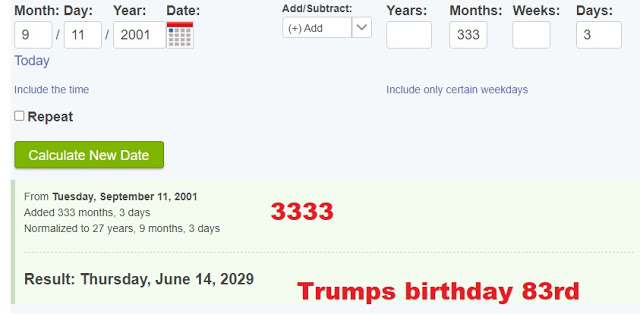
Remember the 2222 number ..... From 9/11/2001 to Trump calling national emergency was 222 months and 3 days .... Now look at 333 months 3 days from 9/11 it falls on Trump's 83rd birthday or 996 months.... It's also flag day....


83 years is 996 months
Trump will be 996 months old... 
"September eleven" = 996 (English Sumerian)


From and including: Sunday, January 26, 2014
To, but not including Monday, February 27, 2023
Result: 3319 days
Or 9 years, 1 month, 1 day = 911

From and including: Sunday, January 26, 2014
To, but not including Wednesday, March 8, 2023
Result: 3328 days
Or 9 years, 1 month, 10 days excluding the end date.
911.78% of a common year (365 days)

"year of the rabbit" = 155 (English Ordinal)
"coronavirus" = 155 (English Ordinal)

year of the rabbit starts on 1/22/2023 

"January twenty second two thousand twenty three Year of the rabbit" = 777 (Reverse Ordinal)

"ten ten phoenix twenty eighteen" = 122 (Chaldean)
"Fednow 2023" = 74 (English Ordinal)


Yellen calls for more control on crypto in 2023 .... 
Yellen co-ordinates with the FED move in 2023 

The report details a multiyear effort to bolster IRS enforcement that would bring in as much as $700 billion in tax revenue over the next 10 years. The proposed changes, if implemented, would go into effect starting in 2023.


https://techcrunch.com/2021/05/20/new-cryptocurrency-irs-rules-2023-crypto/


Wednesday, June 1, 2016

Congress launches probe of NY Fed over handling of $80M cyberheist


A congressional committee has launched an investigation into the Federal Reserve Bank of New York's handling of the heist of more than $80 million from accounts it maintains for the central bank of Bangladesh, CNBC has learned.

In a letter to New York Fed President William Dudley on Tuesday, House Science Committee Chairman Lamar Smith, R-Texas, asked for "all documents and communications" related to the cyberheist from the Bank of Bangladesh account. The committee also wants to know what oversight the Fed has conducted of the SWIFT system, an international electronic messaging system used by banks worldwide to authorize billions of dollars a day in money transfers.

The House committee is requesting a briefing by the New York Fed on the status of its investigations, and "all documents or communications related to any review conducted by the NY Fed of its own information technology."

http://finance.yahoo.com/news/congress-launches-probe-ny-fed-140009660.html

Jews stealing.. Just another day on Planet Earth.. but it's interesting that for ONCE the Congress is going to investigate it? Aren't they afraid of being called anti-Semitic? They're probably just pissed because they didn't get their cut! Judah will pay them and they'll drop it! imo

Thursday, May 14, 2026

As of May 13, 2026, the U.S. Senate has confirmed Kevin Warsh as the 17th chairperson of the Federal Reserve.

 As of May 13, 2026, the U.S. Senate has confirmed Kevin Warsh as the 17th chairperson of the Federal Reserve. 

Key Details on the Appointment:
Confirmation: The Senate confirmed Warsh in a 54-45 vote, with his first FOMC meeting scheduled for June 16-17, 2026.

Background: Warsh is a former Fed governor and has worked with the Duquesne Family Office, bringing a background in investment banking and market mechanics.

Policy Focus: He is expected to prioritize deregulation, lower interest rates, and aggressive trimming of the Fed's balance sheet.
Transition: Warsh takes over from Jerome Powell, whose term as Chair concludes in May 2026. 

5*13+20*26 = 585 

"17th Federal Reserve Chairman Kevin Maxwell Warsh" = 666 (Reverse Ordinal)


"The 17th FED Chairman Kevin M Warsh" = 303 (Ordinal) 
"Jewish FED Chairman" = 303 (Reverse Ordinal)

"17th FED Chairman KM Warsh" = 220 (Ordinal)

"FED KMW 17th" = 107 (Ordinal)
"currency" = 107 (Ordinal)

1*30+20*26+5*13+20*26 = 1135 
"President Donald John Trump" = 1135 (Satanic)
"Masonic Fraternal Police" = 1135 (Reverse Satanic)
"Cascadia subduction zone" = 1135 (Reverse Satanic)
"San Francisco Earthquake" = 1135 (Reverse Satanic)


26+8+57+86 = 177
Wed, 13 May 2026 = 26th of Iyyar, 5786
כ״ו בְּאִיָיר תשפ״ו
Parashat Bamidbar
41st day of the Omer

4*13+19*70+5*13+20*26= 1967

Wednesday, February 24, 2021

Fed blames ‘operational error’ that crashed Fedwire, other key systems 2/24/21


The Federal Reserve said it is restoring services that were thrown offline Wednesday by an “operational error” that spurred outages in a dozen areas, including check clearing and Fedwire, which handles trillions of dollars in transactions daily for the world’s biggest banks.

“A Federal Reserve operational error resulted in disruption of service in several business lines,” the Fed told Reuters in an emailed statement. “We are restoring services and are communicating with all Federal Reserve Financial Services customers about the status of operations.”

All nine of the Fed’s electronic services crashed in the early afternoon, and by 2:30pm EST, had been restored, but the key Fedwire Funds system that allows banks to settle large payments like mortgages or commercial loans, and acts as a clearinghouse for financial institutions executing major transactions, was still down.

The affected services form the hidden backbone to the US banking system, facilitating check clearing and allowing billions of dollars of payments to flow daily through the financial system, including credit and debt transfers, and all transactions of US Treasury bonds.

The outage was being mocked and celebrated on social media by cryptocurrency supporters who have long supported electronic ledger blockchain technology as a superior and safer alternative to the Fed’s current system.

https://nypost.com/2021/02/24/fed-blames-operational-error-that-crashed-fedwire/

Thursday, October 4, 2018

Warning: The Everything Bubble is in SERIOUS Trouble October 4, 2018

Warning: The Everything Bubble is in SERIOUS Trouble
October 4, 2018 by IWB

As we have been warning repeatedly over the last few months, the Powell Fed is totally unlike the Bernanke or Yellen Feds.

Former Fed Chairs Ben Bernanke and Janet Yellen were “married” to the bull market in stocks. Indeed, from 2009 to 2016 it became a running joke that the moment the stock market began to break down, Bernanke or Yellen would issue a statement that the Fed was “ready to act” or some other accommodative phrase.

Stocks would erupt higher. And the bull market remained intact.

Not current Fed Chair Jerome Powell. Powell has made it clear he is going to hike rates until “something breaks.” And he doesn’t meant a minor stock market correction; he explicitly stated that stocks would have to enter a prolonged collapse similar to that of 2008 for him to change the Fed’s monetary policy.

Well, he’s going to get what he asked for.

The US Bond Bubble, which I call “the Everything Bubble” is beginning to blow up.

As we noted previously, the yield on the all-important 10-Year US Treasury has broken its multi-decade downtrend (red line). That was bad enough… but now yields have risen above CRITICAL resistance (blue line).

THIS was the proverbial “line in the sand”… the line which yields needed to NOT break. And they just did.

This move is not exclusive to the 10-Year Treasury either. The 30-Year Treasury has ALSO broken its restively downtrend (red line) and CRITICAL resistance (blue line).

This is a MASSIVE warning to everyone. If you wanted a comparable situation… this is the equivalent of when subprime mortgages started blowing up before the last crisis.

The only difference is that bubble in mortgages/ real estate was a bubble in a relatively senior asset class. The bubble in sovereign bonds is a bubble in THE MOST senior asset class… the bedrock of the entire global financial system.

Did the next crisis just start? We are about to find out!

I am currently looking for a -30 to -40% correction in SPY by mid-March 2019. Will I be right?

http://www.investmentwatchblog.com/warning-the-everything-bubble-is-in-serious-trouble/


Saturday, April 25, 2020

Repo markets were taken over by the FED September 17th 2019

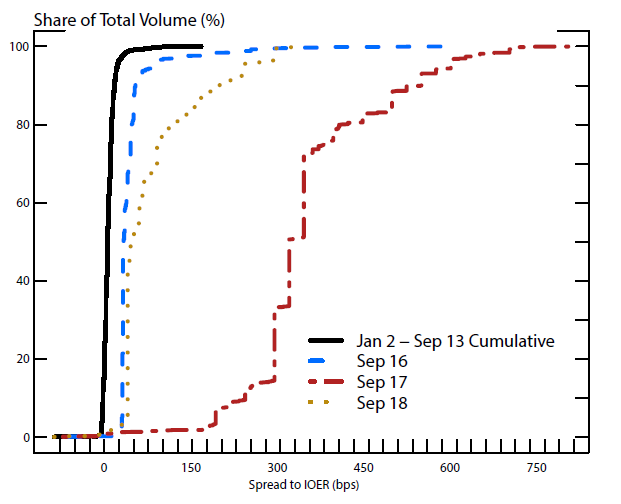
Figure 2: Distribution of SOFR Volumes. See accessible link for description.


Why did repo rates spike in September?

A mid-September cash crunch led to a spike in very short-term rates in the repo markets, where banks exchange high-quality collateral for cash with an agreement to buy back those assets with interest. ... Fed officials have puzzled over the banks' unwillingness to lend into the market when the Sept. 17 disruption happened.

What Happened in Money Markets in September 2019?1
Sriya Anbil, Alyssa Anderson, and Zeynep Senyuz

In mid-September 2019, overnight money market rates spiked and exhibited significant volatility, amid a large drop in reserves due to the corporate tax date and increases in net Treasury issuance. Although some upward pressure on money market rates due to these seasonal factors was expected, the extent of the increase in both the level and volatility of rates in secured and unsecured markets was surprising. In this note, we review the money market events of September 2019 and discuss the factors that may have contributed to the sharp rate movements in the repo market and the associated pressures in the fed funds market.

What happened?
The moves in both secured and unsecured rates on September 16 and 17 were much larger than any of those observed over the past few years. Figure 1 shows the effective federal funds rate (EFFR) and the secured overnight financing rate (SOFR), a broad measure of the cost of borrowing cash overnight collateralized by Treasury securities, since December 2015. The EFFR has been quite stable and only printed outside the FOMC's target range on one day before September 17. While SOFR has been more volatile compared to the EFFR and exhibited some quarter-end seasonality, it rarely moves more than 20 basis points on a day.

On Monday, September 16, SOFR printed at 2.43 percent, 13 basis points higher than the previous business day. With pressures in the repo market spilling over into the fed funds market, the EFFR printed at 2.25 percent, 11 basis points above the Friday print and at the top of the FOMC's target range. On September 17, the EFFR moved above the top of the target range to 2.3 percent and the SOFR increased to above 5 percent.

Figures 2 and 3 show the shift in the distribution of trades in the repo market and the fed funds market, respectively. On September 16 and 17, the range of trades in both markets expanded significantly and rates shifted higher. Following the repo operations by the Federal Reserve Bank of New York (FRBNY), announced on September 17, the distribution of rates in both markets reverted closer to the average distributions observed over the year the next day.

https://www.federalreserve.gov/econres/notes/feds-notes/what-happened-in-money-markets-in-september-2019-20200227.htm


From and including: Tuesday, September 17, 2019
To, but not including Wednesday, March 11, 2020
Result: 176 days
Or 5 months, 23 days = 523
25 weeks and 1 day = 251
48.22% of a common year (365 days)

From and including: Tuesday, September 17, 2019
To and including: Wednesday, March 11, 2020
Result: 177 days
Or 5 months, 24 days
25 weeks and 2 days
48.49% of a common year (365 days)

From and including: Tuesday, September 17, 2019
To, but not including Friday, March 13, 2020
Result: 178 days
Or 5 months, 25 days
25 weeks and 3 days
48.77% of a common year (365 days)

From and including: Tuesday, September 17, 2019
To and including: Friday, March 13, 2020
Result: 179 days
Or 5 months, 26 days
25 weeks and 4 days
49.04% of a common year (365 days)

From and including: Tuesday, September 17, 2019
To, but not including Tuesday, January 21, 2020
Result: 126 days
Or 4 months, 4 days
18 weeks
34.52% of a common year (365 days)

From and including: Tuesday, September 17, 2019
To, but not including Tuesday, May 5, 2020
Result: 231 days
Or 7 months, 18 days
33 weeks

Trump Iran tweet points to 6/5/2020 too. 

Trump tweet timestamp 8:08 AM the 488th minute of the day
https://twitter.com/realDonaldTrump/status/1252932181447630848?s=20

"Blood Moon Eclipse" = 488 (Jewish)

Four lunar eclipses will appear across Earth's skies in 2020. They will all be penumbral eclipses, which means the face of the moon will appear to turn a darker silver color for a few hours. Weather permitting, people across most locations on our planet will catch at least one of the lunar eclipses falling on Jan. 10-11, June 5-6, July 4-5 and Nov. 29-30.

Next one is 6/5 and 6th...

From Iran satellite launch to blood moon eclipse is 44 days.
From and including: Wednesday, April 22, 2020
To, but not including Friday, June 5, 2020
Result: 44 days

Monday, August 23, 2021

JFK printed money on 6/4/1963

 JFK printed money on 6/4/1963 

From and including: Tuesday, June 4, 1963
To, but not including Friday, November 22, 1963
Result: 171 days

"Federal Reserve Bank" = 171 (English Ordinal)
"Federal Reserve Bank" = 315 (Reverse Ordinal) 3/15 is the Ides of March. 
"The Federal Reserve Bank" = 1122 (English Extended)

The FED act was passed on 12/23 the first full day of the FED's existence was 12/24
"The Federal Reserve Bank" = 1224 (English Sumerian)

The FED was created on in 1913 the first full year of the FED's existence was 1914
"The Federal Reserve System" = 1914 (Jewish)

"Federal Reserve System" = 322 (Francis Bacon)
"Federal Reserve System" = 1776 (Reverse English Sumerian)
US birthday is 74 and 74 * 24 (hours in a day) = 1776 

"United States Dollar" = 919 (Jewish)
A World At Risk by the World Health Organization released on 9/19/19

From 9/19/19 to 3/11/20 was 174 days 
"New World Order" = 174 (English Ordinal)
"number of the beast" = 174 (English Ordinal)
"False flag" = 174 (Reverse Ordinal)
"currency reset" = 174 (English Ordinal)
"crypto currency" = 174 (Reverse Ordinal)
"flu vaccine" = 174 (Reverse Ordinal)

Federal Reserve turns 1440 sidereal months old on 9/11/21 

From and including: Tuesday, December 23, 1913
To, but not including Saturday, September 11, 2021
Result: 39,344 days
39344 / 27.322 = 1440.011

There are 1440 minutes in a day. 
"phi equals one point six one eight" = 1440 (Jewish)
"Total Lunar Eclipse Rapture Date" = 1440 (Jewish)
"Time" = 144 (Jewish)

"beast system" = 1440 (Trigonal)
"global economic collapse" = 1440 (Trigonal)


Monday, April 27, 2020

Flagging May 4th and 5th for a market event

 I'm flagging May 5th 2020 for a market event....A lot of people don't know that the FED had to inject 500 million dollars into the repo markets because the credit line interest rate shot up. It froze the credit market and the banks were refusing to lend even for higher interest rates. The FED had to come in and save it with 500 mil. That happened on 9/17/2019. On 5/5 it will be exactly 33 weeks....

The event started on 9/16 so it could be landing 33 weeks on May 4th. That's a Monday too.

So I'm flagging both Monday May 4th and Tuesday May 5th.

From and including: Tuesday, September 17, 2019
To, but not including Tuesday, May 5, 2020
33 weeks

This probably has something to do with the virus release. Maybe corona is just another bank robbery!

May 5th hebrew calendar....
Tue, 5 May 2020 = 11th of Iyyar, 5780
י״א בְּאִיָיר תש״פ
Parashat Emor (in Diaspora)
26th day of the Omer

Iyar is the eighth month of the civil year and the second month of the ecclesiastical year on the Hebrew calendar.
Tue, 5 May 2020 = 11th of Iyyar, 5780 = 11/2 or 11/8
5/5/2020 roman numerals
"V.V.MMXX" = 118 (English Ordinal)
"V.V.MMXX" = 44 (Reverse Ordinal)
"V.V.MMXX" = 28 (Full Reduction)
"V.V.MMXX" = 26 (Reverse Full Reduction)
"V.V.MMXX" = 2060 (Jewish)

Here's my work on the frozen repo market event.

"repo markets" = 141 (English Ordinal)
"repo markets" = 156 (Reverse Ordinal)
"repo markets" = 511 (Jewish)

Repo markets were taken over by the FED September 17th 2019


https://decodingsatan.blogspot.com/2020/04/repo-markets-were-taken-over-by-fed.html

Friday, April 21, 2023

interesting numbers 1338, 65, 137, 228, 44, 1911, 210 Repo markets to 5/17

 interesting numbers 1338, 65, 137, 228, 44, 1911, 210 Repo markets to 5/17


A lot of people don't know that the FED had to inject 500 million dollars into the repo markets because the credit line interest rate shot up. It froze the credit market and the banks were refusing to lend even for higher interest rates. The FED had to come in and save it with 500 mil. That happened on 9/17/2019.

From and including: Tuesday, September 17, 2019
To, but not including Wednesday, May 17, 2023
Result: 1338 days
1338+8331 = 9669 = 9*6*9 + 969 = 1455 + 5541 = 6996 / 9669 / 2 = 1338 
Or 3 years, 8 months= 38 = death 
44 months = kill 
1911 = freemasonry 

Here's my work on the frozen repo market event.

"repo markets" = 141 (English Ordinal)
"repo markets" = 156 (Reverse Ordinal)
"repo markets" = 511 (Jewish)

Repo markets were taken over by the FED September 17th 2019


Monday, October 8, 2018

10/8/18 Market.... #108 #627


six two seven (Hebrew) 
"שש שתיים" = 19 (Hebrew Reduction) = 10/9


627 (Trader's badge number 'The Street' 10/8/2018) 

In the beginning = 627 SAT
Morals and Dogma = 627 SAT
Masonic lodge = 627 RSAT
World Currency = 627 RSAT
Golden Globes = 627 RSAT (1/9/2019)
Dead Sea Scrolls = 627 SAT
false messiah = 627 SAT
Sabbatai Zevi = 627 RSAT
School shooter = 627 SAT
The first purge = 627 SAT
Celebrity death = 627 SAT
The Queen is dead = 627 SAT
Ritual Murders = 627 RSAT
Harry and Meghan = 627 SAT
conservatives = 627 SAT
Forty ninth day = 627 RSAT
twelve squared = 627 SAT
Ancient Babylon = 627 SAT

"DCXXVII" = 41 (Full Reduction) (627)


U.S. Stocks Weaken as Global Markets Tremble From Sharp China Selloff

Global equities tremble Monday as investors in China returned from their Golden Week celebrations and slashed prices for domestic stocks amid the ongoing trade and diplomatic tensions between Washington and Beijing, while markets in Europe were pinched by rising interest rates and slowing growth signals in most of the world's major economies.

 Martin Baccardax  Oct 8, 2018 6:55 AM EDT
"Martin Baccardax" = 52 (Jewish Reduction)
Martin = 26....  Baccardax = 26


The Monday Market Minute

Global stocks extended declines Monday, as markets in China fell the most since February, as trade and diplomatic tensions between Washington and Beijing pressure investors around the world.

The U.S. dollar index remains elevated in foreign exchange markets following Friday's strong payroll data, keeping emerging market and Asia stocks on the back foot as risky asset re-pricing.

Bond yields continue to rise, with benchmark 10-year Treasuries trading at 3.23% ahead of $230 billion in fresh supply this week, including 3-year, 10-year and 30-year paper.

European stocks tumble amid China concern, weaker-than-expected German industrial data and the ongoing standoff between Italy and the EU over spending plans.
U.S. equity futures are weaker, with the Dow looking at a 70 point opening bell decline, but with bond markets closed for the Columbus Day holiday, volatility could increase.

Market Snapshot

Global equities trembled Monday as investors in China returned from their Golden Week celebrations and slashed prices for domestic stocks amid the ongoing trade and diplomatic tensions between Washington and Beijing, while markets in Europe were pinched by rising interest rates and slowing growth signals in most of the world's major economies.

U.S. equity futures, however, are attempting to hold their ground, although the Dow Jones Industrial Average is expected to open 70 points lower at the opening bell, while the broader S&P 500 is looking at a 9 point pullback, as the "risk-off" sentiment from Europe and China ripples through markets and investors brace for $230 billion in new Treasury bond sales just days after the biggest fixed income selloff in nearly two years.

Benchmark 10-year government bonds yields held steady at 3.23% in overnight trading, although bond markets in the U.S. will remain closed today owing the Columbus Day holiday, with investors prepping for one of the most active weeks of the year for new bond sales that includes $72 billion in 3-year, 10-year and 30-year paper.

China's Shanghai Composite fell 3.7% by the close of trading, while the tech-focused CSI 300 slumped 4.3% as investors dumped stocks following a series of headline risks last week, including allegations of China meddling in U.S. elections by President Donald Trump and the potential 'back door' hacking of servers linked to tech giants Amazon (AMZN) and Apple (AAPL) .

The People's Bank of China attempted to mitigate some of those concerns Sunday, when its cut the so-called Reserve Requirement Ratio for its domestic banks in a move that will free up around $110 billion in fresh liquidity, but the market's desire to "catch up" to last week's global equity declines was simply too powerful.

https://www.thestreet.com/markets/us-stocks-weaken-as-global-markets-tremble-from-sharp-china-sell-off-14736305


Yields on Italian Bonds Hit 4½ Year High on Budget Concerns

Selloff of Italian bonds and banks revives concerns over the “doom loop” between weak lenders and fragile government finances

By Georgi Kantchev

Oct. 8, 2018 7:05 a.m. ET

Investors continued to sell off Italian government bonds on Monday as the country’s populist government clashed with the European Union over budget targets.

Yields on the country’s 10-year bonds hit a 4½ year high, rising 17 basis points to 3.593%. The two-year bond yield jumped to 1.557% near its highest level since June. Bond yields move inversely to prices.

https://www.wsj.com/articles/yields-on-italian-bonds-hit-4-year-high-on-budget-concerns-1538996710

Could Italy be the next Greece? Investors show growing concerns

Comparing the Italian 10-year bond to other government bonds in Europe, only Greece has a higher yield.

Greece's yield on the 10-year bond is at 4.64 percent; whereas the equivalent yields in Portugal and Spain are at 1.95 and 1.59 percent, respectively.

The difference between these four yields suggest that Greece and Italy are seen to be riskier than Portugal and Spain.

 @Silvia_Amaro

Italian government bonds are increasingly seen as riskier investments given the anti-establishment Cabinet and its public spending plans — so much so, that Italian bonds are moving closer to being seen to be as risky as Greece's.

The yield on the 10-year Italian government bond is currently at 3.58 percent — the highest level in over five years.

The yield (or interest rate) on a bond — which is basically a piece of paper that, in this case, a government sells to raise money — indicates the perception that investors have about that investment.

For instance, if the yield on a bond is moving higher, it suggests that investors are associating more risk with that bond and, consequently are demanding a higher rate of interest in return for their investment.

Comparing the Italian 10-year bond to other government bonds in Europe, only Greece has a higher yield. Greece's yield on the 10-year bond is at 4.64 percent; whereas the equivalent yields in Portugal and Spain are at 1.95 and 1.59 percent, respectively.

https://www.cnbc.com/2018/10/08/could-italy-be-the-next-greece-bond-investors-show-growing-concerns.html


Watch FANG Stocks for Warning of Fed Mistake, Says Julius Baer


(Bloomberg) -- If the Federal Reserve tightens U.S. monetary policy too far, investors in the bull market’s biggest winners will feel the pain first, according to Bank Julius Baer & Co. That’s tech stocks.

Strong economic growth will encourage the Fed to keep raising interest rates, even if the tightening sucks out more liquidity than financial markets can tolerate, said Yves Bonzon, chief investment officer at Julius Baer. That could drive the S&P 500 Index down about 20 percent before the equity losses start moderating the central bank’s actions, he said.

“I’m the most nervous I’ve been in a long time because I think we’re approaching that point,” he said at a press roundtable in Hong Kong on Monday, referring to when Fed tightening starts to drive a reversal in stocks. “The biggest beneficiary of the expansion of liquidity will be the biggest casualty, irrespective of their fundamentals.”

Bonzon says that the interplay between economic data and the share prices of the FANG stocks -- a loose grouping variously consisting of Facebook Inc., Apple Inc., Amazon.com Inc., Microsoft Corp., Netflix Inc., and Google parent Alphabet Inc. -- is his favored way to gauge whether liquidity conditions pose a risk to the broader market. The Swiss private bank has been reducing its holdings of U.S. stocks, while remaining “modestly overweight,” he said.

While the S&P 500 has powered to a string of all-time highs this year even against the backdrop of Fed interest-rate increases, the rally is facing a renewed threat from surging Treasury yields and the risk of economic fallout from the U.S.-China trade war. The NYSE FANG+ Index topped out in June, three months before the broader market’s current peak, and has fallen 13 percent since then.

https://www.bloombergquint.com/markets/watch-fang-stocks-for-warning-of-fed-mistake-says-julius-baer#gs.SisEY7E


Wednesday, November 17, 2021

World War One

 Archduke Franz Ferdinand was assassinated by the black hand secret society on 28 June 1914. 

"Archduke Franz Ferdinand assassinated" = 144 (Full Reduction)
"Archduke Franz Ferdinand assassinated" = 1369 (Fibonacci) 37*37=1369 

"Archduke Franz Ferdinand" = 211 (English Ordinal)
"Archduke Franz Ferdinand" = 112 (Full Reduction)

The FED was created on 12/23/2013. Private bankers wanted to run up debt so they started WW1. 
From the FED creation to Ferdinand assassination was 187 days... 
From and including: Tuesday, December 23, 1913
To, but not including Sunday, June 28, 1914
Result: 187 days
The secret society the "Black Hand" assassinated Archduke Franz Ferdinand
"Serbia" = 187 (Jewish)
"black hand" = 187 (Reverse Ordinal)
"Society of Jesus" = 187 (Reverse Ordinal)
"War of the worlds" = 187 (English Ordinal)
"Ancient Accepted Scottish Rite of Freemasonry" = 187 (Full Reduction)

The black hand was founded on 5/9/1911 
"Freemasonry" = 59 (Reverse Full Reduction)
"Ancient and Accepted Scottish Rite of Freemasonry" = 1911 (Jewish)
277 is the 59th prime number
"Archduke Ferdinand assassinated" = 277 (English Ordinal) 59th prime
"Archduke Ferdinand assassinated" = 115 (Full Reduction)
"Scottish Rite Freemasonry" = 115 (Full Reduction)

Black hand founded on 5/9/1911
Tue, 9 May 1911 = 11th of Iyyar, 5671
"י״א בְּאִיָיר תרע״א" = 113 (Hebrew Ordinal)
Parashat Emor (in Diaspora)
26th day of the Omer
5+9+1+9+1+1=26
"Ferdinand assassinated" = 206 (English Ordinal)
"twenty sixth day of the Omer" = 115 (Full Reduction)
"Archduke Ferdinand assassinated" = 115 (Full Reduction)
"Scottish Rite Freemasonry" = 115 (Full Reduction)
"twenty sixth day of the Omer" = 322 (English Ordinal)
Torah Portion: Leviticus 21:1-24:23  
Parashat Emor describes purity rules for priests (כֹּהֲנִים, Kohanim), recounts the holy days, describes the preparations for the lights and bread in the sanctuary, and tells the story of a blasphemer and his punishment. 
Date in Hebrew 11/2/5671 
"Archduke Franz Ferdinand" = 112 (Full Reduction)
"Archduke Franz Ferdinand" = 211 (English Ordinal)
Torah Portion: Leviticus 21:1
or 11/8/5671 

Assassination date 6/28/1914 
Sun, 28 June 1914 = 4th of Tamuz, 5674
"ד׳ בְּתַמּוּז תרע״ד" = 1133 (Hebrew Soffits) in duo 1911 (year black hand was founded) 
"Ancient and Accepted Scottish Rite of Freemasonry" = 1911 (Jewish)
Parashat Chukat
Parashat Chukat is the 39th weekly Torah portion in the annual Jewish cycle of Torah reading.
Torah Portion: Numbers 19:1-22:1  
"Society of Jesus" = 191 (English Ordinal)
Parashat Chukat sets out the laws of corpse contamination (tumat hamet) and purification with the water of lustration prepared with the Red Cow (פָרָה אֲדֻמָּה, parah adumah, also called the “Red Heifer”). 

From the founding of the black hand to the creation of the FED was 137 weeks 
From and including: Tuesday, May 9, 1911
To, but not including Tuesday, December 23, 1913
137 weeks the 33rd prime number 

From the founding of the black hand to the assassination of the Archduke was 1146 days 
From and including: Tuesday, May 9, 1911
To, but not including Sunday, June 28, 1914
Result: 1146 days
"Society of Jesus" = 1146 (English Sumerian)
"assassination" = 1146 (Reverse English Sumerian)
"War of the worlds" = 1146 (Reverse English Sumerian)

Rosicrucian temple in the US was created in 1911 also.
Mount Ecclesia (dedicated on October 28, 1911) is the location of the international headquarters of the fraternal and service organization The Rosicrucian Fellowship (TRF), located on grounds in Oceanside, California. It is also the location of its spiritual temple, called The Ecclesia.

5/9/1911 to 10/28/1911 was 172 days
"Ad maiorem dei gloriam" = 172 (English Ordinal)
10/28/1911 to 6/28/1914 was 33 months exactly 
10/28/1911 to 12/23/1913 was 787 days
 
Sun, 28 June 1914 = 4th of Tamuz, 5674
4th or Tamuz = 4/4 
"The Black Hand" = 44 (Full Reduction)
"jachin boaz" = 44 (Full Reduction)
4+4+56+74 = 138
"master mason" = 138 (English Ordinal)


Hidden history of WW1 by Dr Shiva 

My earlier work on Rosy Cross 


World war three starts in Ukraine... My Ukraine work 


They also use gematria and numerology to send messages and organize events. The group that assassinated the Archduke was called the hidden hand and they were created in 1911. The Rosicrucian founded their US temple in 1911 also. The King James Bible was released in 1611 flip the 6 and it's a 9 . The number 1911 is 
"Ancient and Accepted Scottish Rite of Freemasonry" = 1911 (Jewish) 

Dates Black hand 5/9/1911, Rosicrucian temple 10/28/1911,  the Titanic sinking 4/15/1912, the FED /12/23/1913, Assassination of Archduke 6/28/1914 = WW1 begins , Lusitania sinks 5/7/1915, US enters WW1 4/6/1917, Romanovs murdered 7/17/1918, End of WW1 11/11/1918. 

It was all the same big operation. 

From and including: Tuesday, May 9, 1911
To, but not including Monday, November 11, 1918
Result: 2743 days

add the end date
From and including: Tuesday, May 9, 1911
To and including: Monday, November 11, 1918
Result: 2744 days
Or 90 months, 3 days including the end date.
392 weeks

war
From and including: Sunday, June 28, 1914
To, but not including Monday, November 11, 1918
Result: 1597 days
Or 4 years, 4 months, 14 days excluding the end date.
Or 52 months, 14 days excluding the end date.
228 weeks and 1 day
437.53% of a common year (365 days)

From and including: Saturday, October 28, 1911
To, but not including Monday, November 11, 1918
Result: 2571 days
Or 7 years, 14 days excluding the end date.
Or 84 months, 14 days excluding the end date.
367 weeks and 2 days
704.38% of a common year (365 days)


From and including: Tuesday, December 23, 1913
To, but not including Monday, November 11, 1918
Result: 1784 days
"prophecy" = 1784 (Squares)
"Mark of The Beast Is Six Six Six" = 1784 (Jewish)
"Mark of The Beast Is Six Six Six" = 112 (Full Reduction)


Thursday, May 28, 2026

FED

 The Federal Reserve was created on December 23, 1913, when President Woodrow Wilson signed the Federal Reserve Act into law. It was established to serve as the central banking system of the United States, providing a safer, more flexible, and more stable monetary and financial system. 

John Pierpont Morgan Sr. (April 17, 1837 – March 31, 1913) was an American financier and investment banker who dominated corporate finance on Wall Street throughout the Gilded Age and Progressive Era. As the head of the banking firm that ultimately became known as JPMorgan Chase & Co., he was the driving force behind a wave of industrial consolidations in the United States at the turn of the twentieth century.

John Pierpont Morgan Jr. (September 7, 1867 – March 13, 1943) was an American banker and finance executive.[1] He inherited the family fortune and took over the business interests including J.P. Morgan & Co. after his father, J. P. Morgan, died in 1913.

Key Historical Milestones
Initial Operations: The 12 regional Reserve Banks opened for business on November 16, 1914. 
Chicago - Federal Reserve Bank
Structure: The system was designed as a compromise to avoid a single, all-powerful central bank, consisting of a central Board of Governors in Washington, D.C., and 12 regional Federal Reserve Banks. 
Core Duties: Since its inception, the Fed's responsibilities have expanded to include setting the nation's monetary policy, supervising and regulating banks, maintaining the stability of the financial system, and providing financial services to the U.S. government. 

The RMS Titanic sank in the early morning hours of April 15, 1912, disappearing beneath the North Atlantic Ocean at 2:20 a.m. This tragedy occurred roughly two hours and forty minutes after the "unsinkable" ocean liner sideswiped an iceberg on the night of April 14. 

Key Timeline of the Disaster
April 10, 1912: Titanic departed on its maiden voyage from Southampton, England, bound for New York City. 

April 14 (11:40 p.m.): The ship struck an iceberg, buckling the hull and causing five of its supposedly watertight compartments to flood. 

April 15 (2:20 a.m.): The vessel completely slipped beneath the ocean surface. 

Casualties: More than 1,500 passengers and crew lost their lives in the frigid water, making it one of the deadliest peacetime maritime disasters in history. 


Sunday, September 17, 2023

harging Bull will be 34 years old on 12/15/2023


Charging Bull represents Wall Street

If you take the comma out of Charging Bulls co-ordinates and subtract it comes up 33
40.705576 -74.013421= -33.307

November 3rd is the 307th day of the year. It's on a Friday.

On 3/11 they declared a pandemic and on 11/3 they stole an election. They like this number... 

strongs greek 113 "lawless" 
Strongs Hebrew 113 "Lord" 

11*3+20*23 = 493
"Bankrupt" = 493 (Latin)
"Democrats Defeated" = 493 (Latin)
"The Art Of The Deal" = 493 (Latin)

strongs greek 493 "a Christian"
November 3rd is the 307th day of the year
Strongs greek 307 "to make go up" 

rapture?

from Trump inauguration to 11/3 is 354 weeks
Strongs greek 354 "taking up, lifting up"

Fri, 3 November 2023 = 19th of Cheshvan, 5784

Silicon Valley Bank went down 3/10
From and including: Friday, March 10, 2023
To and including: Friday, November 3, 2023
Result: 239 days

Strongs greek 239  "Hallelujah, Praise the Lord.

FED rolled CBDC out on 11/30/2022


Yellen started the CBDC on 11/30/22 
Rosacrucians birthday 10/28/1911

From and including: Wednesday, November 30, 2022
To and including: Saturday, October 28, 2023 (112th Bday)
Result: 333 days


Charging bull's birthday
12*15+19*89 = 1871
our country was turned into a corporation 2/21/1871 
2*21+18*71+12*15+19*89= 3191 mirror 1931 (FED created)

NYSE board created on 3/8/1817 
3*8+18*17= 330
our country was turned into a corporation 2/21/1871 
3*8+18*17+2*21+18*71 = 1650

NYSE created 3/8/1871 ,Trump arrested
3*8+18*17+3*30+20*23= 880
3*8+18*17+11*3+20*23= 823


Monday, May 8, 2023

FED creation to 6/28 or 6/29

 FED creation to 6/28 or 6/29 

From and including: Tuesday, December 23, 1913
To and including: Wednesday, June 28, 2023

Result: 40,000 days


From and including: Tuesday, December 23, 1913
To, but not including Thursday, June 29, 2023

Result: 40,000 days

Or 109 years, 6 months, 6 days 
"currency" = 109 (Reverse Ordinal)
"corona" = 66 (Ordinal)

Or 1314 months, 6 days 
"world domination" = 1314 (Reverse Sumerian)


From and including: Tuesday, December 23, 1913
To, but not including Friday, June 23, 2023

Result: 39,994 days
Or 1314 months excluding the end date.
"world domination" = 1314 (Reverse Sumerian)


June 25th is... 181 days before the FED's 110th anniversary 
From and including: Sunday, June 25, 2023
To, but not including Saturday, December 23, 2023
Result: 181 days

Counting the end date it's 26 = God


Wednesday, June 21, 2023

FED rolled CBDC out on 11/30/2022

 FED rolled CBDC out on 11/30/2022

Plus Trump's birthday
11*30+20*22+6*14+20*23 = 1314

Plus Bo's date
11*30+20*22+6*25+20*23 = 1380

Plus 8/9
11*30+20*22+8*9+20*23 = 1302
"World Currency" = 1032 (Reverse Sumerian)

Plus 8/22
11*30+20*22+8*22+20*23 = 1406 (Trump's birthday)
"A Central Bank Digital Coin" = 416 (Reverse Ordinal)

11*30+20*22+9*10+20*23 = 1320
7*4+17*76 =1320
"President DJ Trump" = 1320 (Reverse Sumerian)
"Donald John Trump" = 1320 (Reverse Sumerian)
"World Currency" = 1032 (Reverse Sumerian)

Strong's Concordance 1320
didaskalos: an instructor, one who teaches concerning the things of God, and the duties of man:
1. of one who is fitted to teach, or thinks himself so: Hebrews 5:12; Romans 2:20.
"Donald John Trump" = 220 (Reverse Ordinal)
of Jesus: John 1:38
"Donald Trump" = 138 (Ordinal)
Strong's Concordance 1320
basar: flesh

From CBDC rollout to 9/10/23 
9 months, 11 days
40 weeks and 4 days = 404
77.81% of a common year (365 days)

From 11/30/2022 at 9:11 AM to 9/10/23 
From: Wednesday, November 30, 2022 at 9:11:00 am
To: Sunday, September 10, 2023 at 12:00:00 midnight
77.70% of a common year (365 days)

That was 283 days, 14 hours, 49 minutes exactly

"283 days 14 hours 49 minutes" = 577 (Ordinal)
577 is the 106th prime number 
"prophecy" = 106 (Ordinal)

"A Central Bank Digital Coin" = 555 (Latin)

From and including: Tuesday, December 23, 1913
To, but not including Sunday, September 10, 2023
Result: 40,073 days
Or 109 years, 8 months, 18 days excluding the end date.
Or 1316 months, 18 days excluding the end date.
40173/27.322 = 1470.35
To 9/1/23
40164/27.322 = 1470.24
There are 1470 windows in the WH. 

Trump Tower was inaugurated on 11/30/1983 
From and including: Wednesday, November 30, 1983
To, but not including Sunday, September 10, 2023
39 years, 9 months, 11 days

To Bo's date

From the date FASB 56 took the books black to 6/25/2023 
10*4+20*18+6*25+20*23 = 1010


Friday, October 16, 2020

FASAB 56 The budget went dark on 10/4/2018


http://files.fasab.gov/pdffiles/sffas_56_nr.pdf


Has the Government Legalized Secret Defense Spending?

While a noisy Supreme Court fight captivated America last fall, an obscure federal accounting body quietly approved a system of classified money-moving


October 4th, 2018, was a busy news day. The fight over Brett Kavanuagh’s Supreme Court nomination dominated the cycle. The Trump White House received a supplemental FBI report it said cleared its would-be nominee of wrongdoing. Retired Justice John Paul Stevens meanwhile said Kavanaugh was compromised enough that he was “unable to sit as a judge.”

#NationalTacoDay trended on Twitter. Chris Evans told the world production wrapped on Avengers 4.

The only thing that did not make the news was an announcement by a little-known government body called the Federal Accounting Standards Advisory Board — FASAB — that essentially legalized secret national security spending. The new guidance, “SFFAS 56 – CLASSIFIED ACTIVITIES” permits government agencies to “modify” public financial statements and move expenditures from one line item to another. It also expressly allows federal agencies to refrain from telling taxpayers if and when public financial statements have been altered.

To Michigan State professor Mark Skidmore, who’s been studying discrepancies in defense expenditures for years, the new ruling ­— and the lack of public response to it — was a shock.

“From this point forward,” he says, “the federal government will keep two sets of books, one modified book for the public and one true book that is hidden.”

Steven Aftergood of the Federation of American Scientists’ Project on Government Secrecy was one of the few people across the country to pay attention to the FASAB news release. He was alarmed.

“It diminishes the credibility of all public budget documents,” he says.

I spent weeks trying to find a more harmless explanation for SFFAS 56, or at least one that did not amount to a rule that allows federal officials to fake public financial reports.

I couldn’t find one. This new accounting guideline really does mean what it appears to mean, and the details are more bizarre than the broad strokes.

https://www.rollingstone.com/politics/politics-features/secret-government-spending-779959/


"Federal Accounting Standards Advisory Board" = 1776 (Satanic)
"Federal Accounting Standards Advisory Board" = 411 (English Ordinal)

"FASAB 56" = 185 (English Sumerian)
"US dollar collapse" = 185 (English Ordinal)
"stock market crash" = 185 (English Ordinal)
"Donald John Trump" = 185 (English Ordinal)
"October fourth" = 185 (Reverse Ordinal)

"FASAB 56" = 111 (Jewish)
"FASAB 56" = 45 (Reverse Full Reduction)

"FASAB" = 106 (Reverse Ordinal)
"FASAB" = 174 (English Sumerian)

"FASAB fifty six" = 147 (English Ordinal)

"Federal Accounting Standards Advisory Board 56" = 1787 (Satanic)277th prime
"Federal Accounting Standards Advisory Board fifty six" = 740 (Reverse Ordinal)
"Federal Accounting Standards Advisory Board fifty six" = 4440 (Reverse English Sumerian)
"Federal Accounting Standards Advisory Board fifty six" = 214 (Full Reduction)
the 214th prime number is 1307


The Presidential report was the day before the FASAB 56 change... 10/3

That night the bond yield jumped...

Yield on the ten year treasury takes off on 10/3 

Presidential alert was on October 3rd 2018 at 2:18 PM EDT 

"Emergency Alert 2:18 PM EDT" = 103 (Full Reduction)
"bond market" = 103 (English Ordinal) (sell off starts the next day on 10/4 ) 

Presidential alert 10/3 
13 months 13 days since the eclipse... 
Time of the Presidential alert...
"October 3rd 2018 2:18 PM EDT" = 1313 (Trigonal)
Stock market crash
"שוק המניות לקרוס" = 1313 (Hebrew Gematria)
"שוק המניות לקרוס" = 1313 (Hebrew Soffits)

Presidential alert was to signal the PLANNED market selloff starting the next day on 10/4/2018 

Donald Trump is 88 and Donald John Trump is 1110

From and including: Thursday, October 24, 1929
To, but not including Thursday, October 4, 2018
Or 88 years, 11 months, 10 days excluding the end date
"Trump" = 88 (English Ordinal)
"Donald John Trump" = 1110 (English Sumerian)
"stock market crash" = 1110 (English Sumerian)
"October fourth" = 1110 (Reverse English Sumerian)
"US dollar collapse" = 1110 (English Sumerian)

"You can't always get what you want" = 104 (Full Reduction) October 4th  = 10/4
 
Put the chorus of that song in the calculator exactly as google has it.. 

"No, you can't always get what you want You can't always get what you want You can't always get what you want But if you try sometime you find You get what you need" = 1787 (English Ordinal) 277th prime number 

October 4th is the 277th day of the year with 88 days remaining! 

October 4th is 33 days before the election! 

From and including: Thursday, October 4, 2018
To, but not including Tuesday, November 6, 2018
Result: 33 days 
4 weeks and 5 days = 45 (Trump 45th Prez) 

Creation on the FED on 12/23/1913 to sell off starting on October 4th 2018 
Or 104 years, 9 months, 11 days excluding the end date
104 years = 10/4 .
"You can't always get what you want" = 104 (Full Reduction) October 4th  = 10/4  
"Tishabav" = 911 (Jewish)

10/4/2018 was Saint Francis of Assisi day

Saint Francis died on 10/3/1226 at 44 years old

So he dies on 10/3 Presidential Alert and he's celebrated 10/4 the day the market began selling off.
"Francis of Assisi" = 103 (Reverse Full Reduction) 10/3
From and including: Saturday, October 3, 1226
To, but not including Wednesday, October 3, 2018
Or 792 years excluding the end date.
"Catholic Church" = 792 (English Sumerian)
"Roman Catholic" = 792 (English Sumerian)
"trumpets" = 792 (English Sumerian)
"Jorge Bergoglio" = 792 (Reverse Primes)
"King James" = 792 (Jewish)

From and including: Thursday, October 4, 2018
To, but not including Sunday, August 11, 2019
Result: 311 days

August 11th 2019 was Tishabav 
311 is the 911th minute of the day 
"Tishabav" = 911 (Jewish)

FASAB notice signed by Monica R Valentine 

"Monica R Valentine" = 1133 (Jewish) Duo of: 1911
"Ancient and Accepted Scottish Rite of Freemasonry" = 1911 (Jewish)
"Iesous Christos Theou Uios Soter" = 1911 (Jewish)

Or 10 months, 7 days excluding the end date.
10/7 day of creation

From FASAB 56 to pandemic 
From and including: Thursday, October 4, 2018
To, but not including Wednesday, March 11, 2020
Result: 524 days

"Freemasonry" = 524 (Satanic)
"storm chaser" = 524 (Satanic)
"Its all a show" = 524 (Satanic)


2 hours and eighteen minutes is 138 minutes altogether

2 hours and 18 minutes = 138 Minutes

"Donald Trump" = 138 (English Ordinal)

FEMA test will last 30 minutes 

2:18 + 30 = 2:48 or 14:48 

14:48 is the 888th minute of the day 

"Donald J Trump" = 888 (English Sumerian)

"THIS IS A TEST" = 888 (Reverse English Sumerian)


From: Wednesday, October 3, 2018 at 12:00:00 midnight 

To: Wednesday, October 3, 2018 at 2:48:00 pm

Result: 14 hours, 48 minutes and 0 seconds

The duration is 14 hours, 48 minutes and 0 seconds

Or 14 hours, 48 minutes

Or 888 minutes 


Creation on the FED on 12/23/1913 to sell off starting on October 4th 2018 

Or 104 years, 9 months, 11 days excluding the end date


Creation on the FED on 12/23/1913 to sell off starting on October 4th 2018 

Or 104 years, 9 months, 11 days excluding the end date

104 years = 10/4 

"Tishabav" = 911 (Jewish)